Aquaponics in Action —Swanky Roots
By Bella Folino, Montana Farmers Union
Government & Outreach Coordinator
With snow on the ground and the temperature in the negatives, where can you find fresh produce grown in Montana? Swanky Roots in Billings has utilized quaponics to keep the growing season going all year round.
Swanky Roots was started in 2016 by mother- daughter team, Rona Klamert and Veronnaka Evenson.
Construction of the site took time and it wasn’t until 2019 for them to be in production.
“I had originally wanted to start smaller, but luckily my mom had a vision,” said Evenson. “She said that we would have to eventually expand, so we might as well start here.”
It was originally Klamert’s idea to try this style of operation. After seeing the idea on line, she reached out to her daughter to see if she was interested. Evenson’s background from her degrees in plant science and ag education from MSU –Bozeman gave her some technical knowledge, even though it was different than what she envisioned.
“My family is in the cattle and wheat / corn industry, so I thought I would be doing something like that. When my Mom asked me about aquaponics, my first thought was: there is no way that will work,” said Evenson, “Then I thought, well, there is no one else doing this, so maybe it is the perfect idea.”
What is
aquaponics?
Aquaponics is the combination of aquaculture and hydroponics. Aquaculture is the cultivation of aquaorganisms, in this case fish. Hydroponics is the process of growing plants without soil. The benefit of combining these two practices is that the facility’s only input into their system is the food for the fish.
First step of the process is the aquaculture. The fish are kept in separate tanks where they are fed. There are about 16 tanks with 200 to 500 fish in each.
“What we look for in fish is compatibility in water temperature,” said Evenson. “The plants do best in warm water, so we need fish that do that too.”
Swanky Roots originally started with raising bluegill. In 2023, they switched to raising coi.
The coi became a more efficient choice because it takes less of them to get the same results. Previously, there were about 1000 bluegill in each tank, for a total of 15,000- 20,000 fish. Now they raise approximately 5,000 coi fish in 12 different varieties.
The water from the pools, containing the fish’s waste, is then moved through pipes to where the lettuce is being grown. This provides the necessary nutrients for the plants to grow.
Each day, Swanky Roots plants and harvests 600- 700 heads of lettuce of seven different varieties.
It takes about 60 days from seed to harvest, sometimes up to 70 days in the winter.
Seeds begin in a rockwool sheet for 10- 15 days until they get their roots. They are then moved to a nutrient film technique gutter for about 20 days.
Once they have more roots, they are moved to floating Styrofoam. The water is constantly aerated to keep the roots from rotting.
“The thing about plants is they still need the same stuff whether they are in soil or water,” said Evenson. “Even though I didn’t study this specifically, I still understand plants and the biology behind it.”
After the water makes its way through all of the rows of lettuce, it is then pumped back into the pools for the fish. This keeps everything on a closed- loop system. “We add about 300 – 500 gallons of water a day,”
“That seems like a lot, but we are able to grow lettuce with seven times less water than used traditionally.”
Success, Struggles
Swanky Roots was founded with a focus on sustained ability. Their system creates and uses its own natural fertilizer and keeps it contained within the system. Due to the nature of the connection between the fish and plants, there are very few things that can be added without harming the other.
“We use the phrase ‘beyond organic’ because we are trying to show people that organic is not just a label, you need to look into the practices,” said Evenson.
Any business does not come without struggles. After the first hurdle of site construction, Swanky Roots had to battle with weather and natural resources. Between extremely cold temperatures and heaters going out to a well going bad, there have been times it has been difficult to keep production running.
“We have had three or four winters, where we almost completely shut down,” said Evenson. “And then when the well went bad we had to put in a major water filtration system, water is our livelihood, and that was an unexpected issue.”
For those interested in a similar system in their own garden there are a lot of possibilities. There are a variety of different fishes that can be used in systems, like catfish, gold fish, or trout. Leafy greens grow easiest, but fruiting vegetables – like tomatoes or peppers – can also be successful.
“If you are doing this on a smaller scale, you can grow just about anything,” said Evenson.
For anyone looking to see the facility at Swanky Roots they are open for tours.
Evenson has also enjoyed doing field trips both for school students and local gardening clubs.
Looking Forward
The greenhouse sits on 60 acres and has about 20,000 feet of indoor growing space. On top of the indoor aquaponic facility, there are also grow beds that utilize clay pebbles and flood irrigation to grow a variety of vegetables from swiss chard to tomatoes.
Swanky Roots was recently able to install led grow lights through a grant and has also received a grant for solar panels they hope to have installed by the winter.
With new grow lights and ideal conditions, the growing process could be cut down to about 30 days. At full production, they could ramp up to 1000 heads a day.
“These will hopefully be a huge help,” said Evenson. “In the winter we have to heat the water close to 75 degrees, even when it is negative 30 outside.”
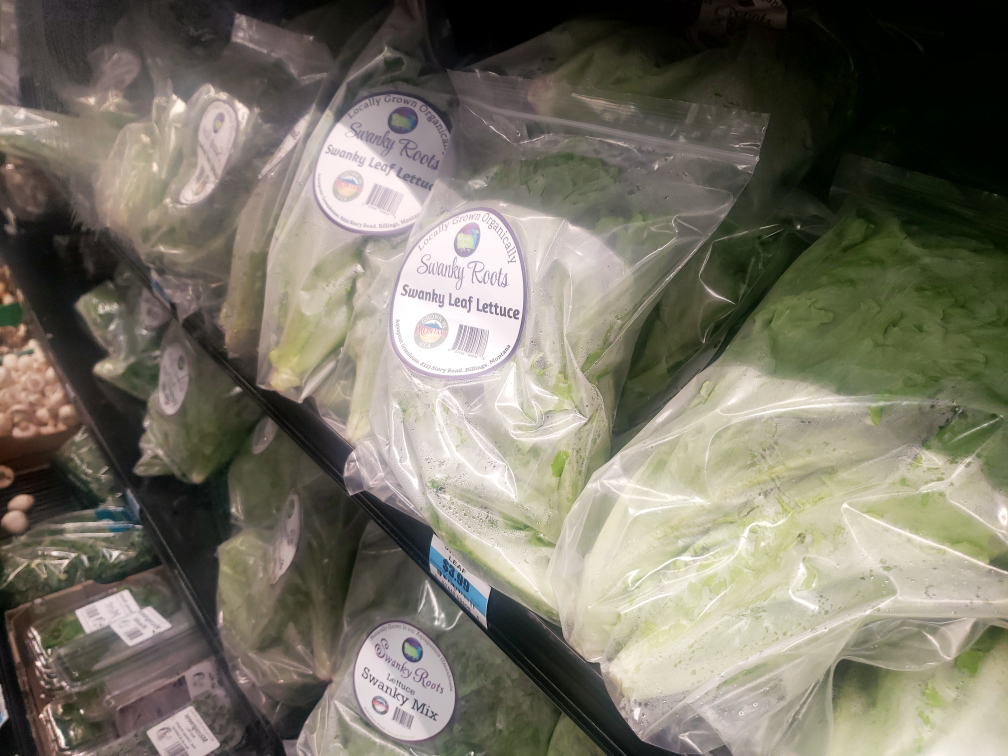
Swanky Roots is also working on expanding their markets. While they started out primarily at restaurants, they can now be found in grocery stores in Billings, Livingston, and Bozeman.
“I try to keep our prices accessible. Our customers have been great about getting the word out,” said Evenson. “I think the product really speaks for itself.”
They are also involved with the Yellowstone Valley Food Hub and, most recently, the Central Montana Food Hub.
On –site, their products can be found at their farm store in Billings where they sell their produce, beef, and other local ly made goodies.

0 comments