Inductees for the Montana Cowboy Hall of Fame Class of 2026, according to the Northern Ag Network are:

District 1 (Daniels, Phillips, Roosevelt, Sheridan, & Valley Counties): Living: Betty Lorraine (Blair) Steele of Malta; Legacy: William C. “Billy” Knorr of Wolf Point.

District 2 (Dawson, Garfield, McCone, Prairie, Richland, & Wibaux Counties): Living: Judd Twitchell of Jordan; Legacy: Jordan Matched Bronc Ride of Jordan.

District 3 (Carter, Custer, Fallon, Powder River, Rosebud, & Treasure Counties): Living: Thomas Ray “Tom” Larsen of Alzada; Legacy: George Albert Pitman of Lame Deer.

District 4 (Blaine, Chouteau, Hill, & Liberty Counties): Living: Ervin George Watson of Box Elder; Legacy: Edmond C. “Ed” Solomon of Havre.

District 5 (Cascade, Glacier, Pondera, Teton, & Toole Counties): Living: Charlotte (Johnson) Barry of Cut Bank; Legacy: Walter “Blackie” Wetzel (Siks-A-Num) of Browning.

District 6 (Fergus, Golden Valley, Judith Basin, Musselshell, Petroleum, & Wheatland Counties): Living: Gerald R. “Jerry” Petersen of Lewistown; Legacy: Charlie Russell Chew Choo of Lewistown.

District 7  (Big Horn, Carbon, Stillwater, Sweet Grass, & Yellowstone Counties): Living: John Will Small of Busby; Legacy: Paul L. “Spike” Van Cleve III of Big Timber.

District 8 (Broadwater, Jefferson, & Lewis and Clark Counties): Living: Ron Mills of Augusta; Legacy: Edward F. Lamb & George W. Lamb of Helena.

District 9 (Gallatin, Meagher, & Park Counties): Living: Jock & Jamie Doggett of White Sulphur Springs; Legacy: Brainard Ranch of Belgrade.

District 10 (Flathead, Lake, Lincoln, & Sanders Counties): Living: T. E. “Buddy” Westphal of Polson; Legacy: Majestic Valley Arena of Kalispell.

District 11: (Mineral, Missoula, & Ravalli Counties): Living: George Gogas of Missoula (Mr. Gogas passed away after being nominated as a Living Inductee and will be honored as such); Legacy: Marvin F. Bell of Hamilton.

District 12: (Deer Lodge, Beaverhead, Silver Bow, Granite, Madison, & Powell Counties): Living: William F. “Bill” Murphy of Garrison; Legacy: Montana Mad Hatters of Twin Bridges.

The Montana Cowboy Hall of Fame will celebrate the 18th class of inductions into the Montana Cowboy Hall of Fame Saturday, February 14, at the Heritage Inn in Great Falls.

Montana’s experience with no speed limits was cited as evidence to implement speed restrictions in Arizona. Center Square reported that the Arizona state legislator, proposing lifting daytime speed restrictions on rural interstate highways claimed that in the mid-1990s when Montana instituted no-speed zones for a few years, officials found two to three times fewer fatalities per vehicle mile traveled than in speed zones. Prior to 1974, Montana had a speed limit of “reasonable and prudent.” That went away for 20 years when a national 55 mph speed limit was enforced. When the national limit was eliminated, Montana went back to the “reasonable and prudent” speed limit in 1995. In 1999, Montana instituted a 75-mph speed limit. Since that time, highway fatalities have increased in Montana. Germany, which has had no speed zones on the Autobahn for 90 years, have had the same experience as Montana under its “reasonable and prudent” restriction, claimed the legislator, Rep. Nick Kupper.

By Sam Cardwell

Mountain States Policy Center

Across the country, raising the minimum wage continues to be a topic of conversation. Some claim that raising the minimum wage to $20 would help both low-income employees as well as employers. Though some are moving forward with this experiment, others are being more cautious.

For example, voters in Olympia, Wash., this year rejected a ballot measure to raise the minimum wage to $20 an hour. California, however, recently enacted this policy for the fast-food sector with disastrous effects. 

On April 1, 2024, California implemented a $20 minimum wage for fast food employees. To fit this definition, an operation has to offer limited or no table service, and customers pay for the items before they are consumed. Also, the restaurant has to be a part of at least 60 establishments nationwide.

The National Bureau of Economic Research found that California’s fast food minimum wage increase led to a detrimental effect on jobs , totaling around 18,000 jobs lost in the fast-food market in California from September of 2023 to September of 2024.  Relative to the rest of the country, employment in California’s fast-food sector declined by 2.7% more during that time period.

Using the 2023 figures from the Bureau of Labor Statistics, a $20 minimum wage imposition for fast food employees would harm the labor force in every state. Washington, Idaho, Montana, and Wyoming should pay attention to these results as they consider similar policies.

Washington state already has a high minimum wage of $16.66 for fast food workers. The industry employs roughly 100,100 fast food employees. Based on the California study, if the state implemented a $20 minimum wage, this would be a 20% increase from its current minimum, resulting in 2,402 jobs lost.

A study done by the Washington Hospitality Association found that eating out in Seattle already costs 17% more than it does on average across 20 major U.S cities. A majority of this unaffordability can be attributed to the high minimum wage, meaning employers have to increase menu prices to make up the cost on their razor-thin profit margin.

Idaho has a minimum wage of $7.25 for fast food workers, and it employs 20,840 workers in the industry. Increasing the minimum wage to $20 would result in 4,395 jobs lost, which would be a major shock to the industry.

Montana has a minimum wage of $9.95 and employs 15,380 fast food employees. With a $20 minimum wage increase, the state would lose about 1,860 jobs. Montana would find itself in a situation that sits right in between the estimated impacts for Washington and Idaho.

Wyoming has a minimum wage of $7.25. The Bureau of Labor Statistics doesn’t have as accurate job numbers for Wyoming and may have suppressed them. This is because Wyoming has a small fast-food employee population, and confidentiality could be breached. The best estimates are around 6,500 fast food jobs. Based on the estimates, a $20 minimum wage would result in a loss of 1,372 fast food jobs.

A simple economic principle is that when the price of something goes up, people will buy less of it. That exact rule applies to labor as well. Large minimum wage increases greatly contribute to job loss. As the wages increase, businesses may be forced to reduce staff to offset higher labor costs, as occurred in California. 

Proposals for large minimum wage increases have become a policy prescription to combat poverty, but they operate on a false premise. It says that raising the minimum wage will improve the well-being of the workers affected, but that is far from the truth. The minimum wage of a fast food worker let go is zero.

States in our region can avoid this outcome. If policymakers really want the best for these fast-food workers, they should avoid proposals that put their jobs in jeopardy. Let California’s failed $20 minimum wage experiment serve as a warning to the rest of the country.

Sam Cardwell is a Policy Analyst for the Mountain States Policy Center, an independent research organization based in Idaho, Montana, Eastern Washington and Wyoming. Online at mountainstatespolicy.org.

By Madi Clark

Mountain States Policy Center

Farmers across the nation are unlikely to be taking a check to the bank at the end of harvest – at least not checks big enough to cover their debt payments. But the government’s so-called remedies are a lesson in contradiction.

As statistics refute themselves, regulations harm more than protect, and trade barriers exasperate challenges facing domestic producers, the government’s role in farming is only adding to the red.

Government data ineptly grasps the financial condition facing farmers. On one hand, the United States Department of Agriculture (USDA) predicts farm income will increase by 21.65 percent for 2025. But at the same time, direct government payments are expected to increase by 354 percent! 

The government is confused by its own statistics and tactics. Despite improved net farm income, federal direct farm support is increasing while farms are dwindling. In all but Idaho, the mountain states exceed the national loss of 8.5% of farms between 2016 and 2024. Data clearly indicates that the numbers and/or tactics are overdrawn.

The only clarification comes for Midwestern farmers. According to the Federal Reserve of Kansas City, midwestern farm lending activity expanded in 2024, with volume of new loans increasing 40% year-over-year. The story hasn’t brightened in the first quarter of 2025, with weakening agricultural credit conditions, while demand for farm loans continues to grow.

Unfortunately for Western farmers, the Federal Reserve of San Francisco only delivers a one-paragraph qualitative summary alluding to the assumptions of industry contacts. But local voices reiterate that the situation isn’t any better for the mountain states.

Fred Burmester, an Idaho hay farmer, said, “It was a really bad year last year. The commodity prices dropped a lot for us… and our production costs were close to the same.” Regarding an operating loan at 9.2 percent that Burmester took out, he said, “It’s going to take years to pay that back.”

State promulgated regulations also add to this financial difficulty for the mountain state region. In 2022, Washington experienced a 40% increase in farm-related expenses, thanks to the removal of the ag overtime exemption. 29.8% of these costs were attributed to an escalation in labor expenses, which had increased by 52% year-over-year. Another major contributor (10%) was expenses attributed to “marketing, storage, and transportation”, due to the carbon tax.

Tariffs exploit another vulnerability of the mountain states because of our reliance on imported agricultural inputs (like fertilizer) and the global retaliation toward American products. Idaho, Montana, Washington and Wyoming ship their agricultural products across the world, and these markets are not easily reclaimed. 

The second Trump Administration’s renewed trade war bounced the check on America’s farm resilience. These recent trade disputes revealed long-existing weaknesses in the agricultural economy. Long-term consolidation and anti-competitive trends among agricultural input suppliers have steadily pinched the agricultural economy. Now, in the face of tighter supply chains and global trade wars, the vulnerability of a low-competition system is apparent.

When 70% of each market space is controlled by 2-3 suppliers, the companies have less economic incentive to be responsive to one farmer’s needs. A recent Senate Judiciary Committee Hearing even listened to testimony on these trends. Senator Grassley (R-IA, Chairman) said, “America’s farmers are the most productive in the world. They take the risk, put in the work and feed the United States and much of the world. But they also operate on thin profit margins.” 

These thin profit margins are quickly giving way to overdrawn farm accounts, despite the USDA’s estimates that the average net farm income was above $80,000 in 2024. For anyone involved in agriculture in the last five years, very few “average” farmers deposited such sums in their bank accounts. Nor is a recovery expected in 2025, with a record corn harvest overflowing the silos and continuing the price decline. 

Yet, the government’s efforts for recovery are more like a teenager with a credit card, rather than a responsible party paying down the debt. Poor data collection outside of midwestern farms, increases in state regulations, disregard for anti-competitive behavior, and resumed trade disputes all continue to hurt farm margins.

We need policies that improve resiliency and decrease farmer vulnerability to government choices.   

Madi Clark is a Senior Policy Analyst for the Mountain States Policy Center, an independent research organization based in Idaho, Montana, Eastern Washington and Wyoming. Online at mountainstatespolicy.org.

By Morgan Sweeney, The Center Square

December’s jobs data changed little from November, rounding out an underwhelming year for the U.S. labor market. 

Initial estimates put job gains at 50,000, though if December is like every other month this year, that number will be revised downward in the coming months. 

By comparison, last December saw an increase roughly 6.5 times greater, with 323,000 jobs added from the previous month. Payrolls rose by an estimated 269,000 from November to December 2023, while pre-pandemic December 2019 posted nonfarm employment growth of 127,000 jobs.

Bruce Yandle, an adjunct fellow at George Mason University’s market-oriented Mercatus Center, described it as “ho-hum.”

“We have about the same level of total employment here in December as we had in January, when the year was starting. And so in a sense, when you look at the report and stare at it… it looks like the world is flat,” Yandle told The Center Square.

The year started off stronger than it finished, with monthly job creation exceeding 100,000 January through April. But May added fewer than 20,000 jobs, and payrolls shrunk by 13,000 from May to June. The rest of the year was inconsistent — modest gains mixed with outright losses.

The latest Job Openings and Labor Turnover Survey provided a sobering glimpse into the realities of the current job market, according to Dave Hebert, a senior research fellow at the American Institute for Economic Research. The JOLTS report reflected a low-hire, low-fire market.

“We’ve been told that a lot of new jobs are going to be coming,” Hebert said. “The claim was that by Q4 of 2025, the economy would be humming.”

GDP growth did accelerate, however, from 3.8% to 4.3% in the third quarter, though fourth quarter growth has yet to be released. But GDP growth is of limited practical value if it doesn’t translate into more jobs.

“We don’t eat GDP growth rates. People work,” Hebert said. 

A cooling labor market and strong economic growth might seem incongruous, but Yandle pointed to third-quarter productivity gains of 4.9% as an explanation. 

“We’ve had zero growth in employment for a year, and we’ve had 4.9% growth in productivity. Zero plus 4.9 is 4.9,” Yandle said.

Yandle and others, including Stanford University economics professor Nicholas Bloom, have said the productivity gains without corresponding labor growth can likely be attributed in part to the proliferation of artificial intelligence. Otherwise, many economists believe the economic uncertainty caused by the continually shifting tariff policy is stifling the labor market. 

Though unemployment has remained relatively low, finishing 2025 at 4.4%, job growth has remained subdued.

“We’re just not seeing that job growth that I think everyone wants,” Hebert said.

By John O’Brien

Legal Newsline

A ballot initiative designed to keep corporations from spending on elections in Montana is a little too ambitious, the state Supreme Court has found.

The new proposals included in Ballot Issue 4 violate the rules for wording such initiatives, the court ruled. State Attorney General Austin Knudsen made that argument to the justices over a vote that would have corporations labeled by the State as “artificial persons.”

The initiative would have said the people of Montana never intended to allow artificial persons to take part in election activity. But it contained other measures, the court ruled, that would leave voters taking on too much – rejecting the idea they were so closely related that voters were deciding essentially a single topic.

“Although BI-4 does not combine unrelated amendments in an attempt to secure support from different groups, it would force voters who support abolishing corporate spending ‘on elections or ballot issues’ to also support, more broadly: 1) limiting the rights of other entities defined as “artificial persons,” such as unincorporated associations and cooperatives; and 2) potentially limiting the powers of such organizations to engage in activities other than election and ballot issue activities in significant but unspecified other ways,” Justice Jim Rice wrote.

Voters must be allowed to express their opinion on each proposed amendment, Rice continued. It’s a loss for Transparent Election Initiative, a group dedicated to fighting against the U.S. Supreme Court’s Citizens United decision, which held that corporate spending on political issues is protected under the First Amendment.

The initiative was called its “Montana Plan” – a first-of-its-kind effort to keep “secret-donor money” out of the state’s elections. It didn’t overturn Citizens United, TEI said, it makes it irrelevant.

“It redefines Montana’s corporations as entities that no longer have the power to spend in politics,” the group said. “And if an entity wasn’t given the power to do something by its creator, whether it has a right to do that thing is irrelevant.”

Groups like the Montana Mining Association and the Montana Chamber of Commerce resisted the initiative. MMA said states cannot use semantics to get around the First Amendment and BI-4 was not tailored to a governmental interest.

The Montana Chamber noted BI-4 if passed would be the longest section in the Montana Constitution by triple.

“BI-4 extends it extreme speech restrictions beyond business corporations and nonprofits by including even ‘unincorporated associations,’” the chamber wrote.

“An ‘unincorporated association’ includes just about any association of two or more people – everything from churches and grassroots protest movements to informal social media groups and living-room discussion groups.

“Even so, BI-4 subjects them to absolute prohibitions on political speech, which implicates their rights to free association and free speech.”

This report was produced by Legal Newsline and distributed by The Center Square as part of a content-sharing agreement. 

Holy Moly Smoke Shop, 821 N 27th St #107, (406) 591-7708, Jennings, Nicholas, Retail Sales J

Jones LLC, 3216 Parkhill Dr, (406) 860-5760, Jones, David/Kelly, Real Estate Rental

Rockrim Rentals, 2916 1/2 Rockrim Ln, (406) 697-8915, Olden, Justin, Real Estate Rental

Cozy Cubz, 417 Hansen Ln Ste #2, (406) 281-0511, Sullivan, Gail, Service

A Honeybzz Haven, 417 Hansen Ln Ste #1, (406) 281-0511, Sullivan, Gail, Service

Off The Roof Gutters and Guards, 631 Custer Ave, (406) 647-4600, Zeiler, Jacob, Service

D.C. Cleaning & Janitorial, 922 Yellowstone River Rd F1, (406) 696-4317, Christie, Dennis, Service

Danny’s Cleaning Service, 421 St John’s Ave, (406) 690-8755, Morrow, Danny, Service

Trailhead Electric, 818 Noblewood Dr, (406) 969-7688, Pantoja, Pantoja, Ereth, John, Antonio, Tristan, Electrical Contractors

Autosport Billings, LLC, 3029 E Copper Ridge Loop, (631) 681-7116, Nejelski, Allen, Service

Bon Appetit, 300 S 24th St W, (571) 320-0049, De Armas, Yanick, Restaurants, 115 Shiloh Rd Suite 2-201

Yellowstone Mushrooms, 7447 Clark Ave, (406) 697-7171, Parker, Andy, Retail Sales, 3242 Durland Dr

NC Movement, 821 N 27th St #107, (406) 591-7708, Jennings, Nicholas, Service

Kelli Hansen Fine Art, 102 N 29th St, (402) 813-0479, Hansen, Kelli, Retail Sales, 3448 Arlene Cir. Apt 1

Best Crowd Management Inc, 308 6th Ave N, (651) 400-7040, Kelly, Anthony, Service, 1699 S Hanley Rd Ste 350, Saint Louis, MO, 63144

The Classy Cowgirl Trading Company, 1167 Hemingway Ave, (406) 696-6588, Jefferson Flores, Vinnett, Retail Sales

Big Sky Fire Protection Systems, 818 Ginger Ave, (406) 672-9695, Tate, Steven, Service

CK Construction & Services Corp, 619 N 2000 W, (801) 731-0717, Checketts, Rob, Service, Ogden, UT, 84404

Montana Maid: Cleaning and Home Services, 5711 Bobby Jones Blvd, (406) 925-0867, Cullen, Kjatlynn, Service

Bens Lawn Care and Snow Removal, 521 Judith Ln, (406) 598-1233, Benjamyn, Herbst, Service

406 IT Solutions, 1607 17th St W #308, (406) 690-4958, Dahlberg, Tucker, Service

Three Feathers Construction, 2023 Fairway Dr, (406) 465-8807, O’Mara, Steve, General Contractors

Atom’s Awesome Anytime Movers, 416 Gay Pl, (406) 717-9778, Price, Adam, Service

406 Glass & Vape (24th St W), 455 S 24th St W, (406) 598-4527, Gerbasi, Marco, Retail Sales, 3705 Montana Ave

406 Glass & Vape (King Ave W),   3130 King Ave W, (406) 647-4439, Gerbasi, Marco, Retail Sales, 3705 Montana Ave,

406 Glass & Vape, 3705 Montana Ave, (406) 647-8389, Gerbasi, Marco, Retail Sales, 3705 Montana Ave. 59101

406 Hockey, 715 Commerce Way, Picicci, Chandra, Retail Sales, 4319 Trotter Ln

Narrow the Road, 3819 Clint Rd, (406) 850-9403, Lawson, Chase, Retail Sales

Duke’s Tree Service, 619 East Main St, (406) 439-1355,  Duke, Chad & Mia, Service, East Helena, 59635, PO Box 110, East Helena, 59635

RZ WC LLC, 4415 March Madness Way #4, (406) 849-8340, Child, Warren, Service

Classy & Sassy Coffee & Fizz Factory LLC, 320 Main St, (406) 370-1752, Dennison, Cassandra, Restaurants, PO Box 51299

Cupbop, 2564 King Ave W Ste A, Layton, Bryan, Restaurants, 6515 Donny Dr

Magic City Greenworks LLC, 12 Monroe St, (406) 672-2226, Coates, Kristopher, Service

Classy & Sassy Coffee LLC (2112 4th Ave N), 2112 4th Ave N, (406) 370-1752, Dennison, Cassandra, Restaurants, PO Box 51299

Cmofo LLC, 1009 Harvard Ave, (406) 672-7751, Groshelle/Ramirez, Jennie/Krista, Real Estate Rental, 8 Amity Lane, Park City, 59063

Autopilot Management Group Inc, 3635 Harvest Time Ln, (205) 519-3604, Estrada, Levi, Real Estate Rental, 17 20th St N Ste 100, Birmingham, AL, 35203

Ohana Ceramics LLC, 1474 S 30th St W Unit 6, (971) 348-9891, Acoba, Max, Service

406 Pure Clean, LLC, 127 J B Stetson St, (406) 702-5653, Badillo, Simon/Arielle, Service

Surestay Plus By Best Western Billings, 3040 King Ave W, (406) 294-9090, Quach, Minh, Hotel & Motels

Jon And Company Builders LLC, 620 Broadwater Ave, (406) 697-1649, Hagstrom, Jon, General Contractors

Brandtson Wayne Reeves Construction LLC, 1025 Avenue F, (406) 694-8853, Reeves, Brandtson, General Contractors

Pacific Decorative Concrete Inc, 5421 Stationers Way, (916) 349-1200, Stratton (President), David, General Contractors, Antelope, CA, 95842

Commonwealth Medical Services LLC, 1101 N 27th St, (859) 286-2592, Marshall (General Counsel), David, Service, 1517 Nicholasville Rd, Ste 201, Lexington, KY, 40503

Second Nature Consulting, 2322 3rd Ave N Ste 230, (406) 647-0205, Sweet, Erik J, Service

Allison Taranto, 28 Avenue B, (406) 942-0415, Taranto, Allison, Real Estate Rental, 5519 County Rd 32, Norwich, NY, 13815

Kernow Inc dba Billings Construction Supply, 5514 King Ave E, (406) 248-8355, Eaves, Lillian, Retail Sales

M6 Liquidation Company, 5234 Sacagawea Dr, (406) 623-0740, Sanderson, Peter B, Retail Sales

Rescue Towing LLC, 430 S Billings Blvd Ste 2, (406) 294-0085, Hanser, Ralph, Service

Quality Towing LLC, 430 S Billings Blvd Ste 3, (406) 294-0105, Hanser, Ralph, Service

Highlander Handyman LLC, PO Box 25, (406) 839-7264, Plubell, Kevin, Service, Ballantine

Aspen Ledger Co LLC, 4822 Chicago Rd, (406) 606-2376, Kolstad, April, Service

Monster Demo LLC, 419 Robertson Rd, (406) 855-5831, Hively, Jarrett, General Contractors

Crownmane, 3025 Gloxinia Dr, (406) 671-7453, Matt, Cavey, General Contractors

Montana Tool Corporation, 3045 Lake Elmo Dr, (406) 670-4244, Youree, Trenton, Retail Sales, 59105

SB Friedman Development Advisors LLC, 70 W Madison St Ste 3700, (312) 424-4250, Dorn, Lance, Service, Chicago, IL, 60602

Denmark first took possession of the large, ice-covered island in the northern Atlantic in the 1700s. The local population is a mix of native Inuit, Norwegians (from the medieval era), and Danes, though the population is only 56,000. The US has seen the defensive and economic potential of the island for over 150 years. (1440.com)

By Mitch Rolling and Isaac Orr

Energy Bad Boys

The prevailing narrative surrounding the power sector is that America’s grid is short of watts, and that we need to vastly increase our power generation capacity to avoid rolling blackouts and meet surging demand for data centers and reindustrialization.

Given the state of the discourse, it may be hard to believe that America has more installed electricity capacity on its grid than ever before. But it’s true. The problem is, so much of this capacity is from unreliable wind and solar facilities that provide almost no reliability value to the grid.

The U.S. technically has more installed capacity on the U.S. grid than ever before, which has increased by 26 percent since 2004 and 12.5 percent since 2015. Meanwhile, electricity demand has only increased by 8.5 percent and 5.6 percent, respectively, during the same timeframes.

The result is that the country has more capacity (MW) per terrawatt-hour (TWh) of generation than ever before.

If “capacity” was the same across all resource types, this data would suggest that we should be more prepared than ever to meet growing electricity demand stemming from data centers and AI.

But we’re not. In fact, the opposite is true.

This begs the question: If the American grid has so much installed capacity on the system, why is it bracing for such severe supply shortages?

The short answer is that the capacity being built today—wind and solar—is far less reliable than the capacity it is replacing—coal and nuclear.

Put simply, wind and solar capacity is not the same as dispatchable capacity due to their intermittency. Intermittent generators are inferior to dispatchable resources for a number of reasons, but mainly because operators cannot control when they produce electricity and when they won’t.

We can forecast when they will or won’t fairly well (but not always), yet that doesn’t give us control over their production levels similar to traditional resources like coal, natural gas, oil, and nuclear. Not to mention, the entire point of forecasting wind and solar production is so that we can use other “backup” resources to supply demand when they aren’t able to, but this backup generation fleet is being retired more and more every year.

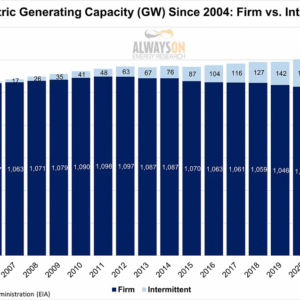
For example, the following chart shows that while intermittent resources like wind and solar have made up the bulk of net resource additions in recent years, firm capacity has been on the decline since 2011 with the exception of a slight rise in 2024.

The result is that the U.S. is now at pre-2005 levels of firm capacity on the grid at a time when electricity demand is projected to have the largest increases in over a decade due to data center and AI growth and electrification efforts.

So, even though the grid as a whole has more capacity than it did 20 years ago, the growth is made up entirely of resources that may be producing no electricity whatsoever when needed the most, and the system has roughly the same levels of firm, reliable capacity online as it did in 2004.

The result of this trend is obvious: supply shortages.

And it’s happening in pretty much every regional grid in the country.

Commercial

SMBC Leasing & Finance Inc|Jones Construction Inc, 1629 King Ave W, Com Remodel, $370,940

Roman Catholic Bishop Of Great|Wegner Homes, 2202 Colton Blvd, Com Remodel, $98,560

Rhett Holyoak |Wagenhals Enterprises Inc, 1722 Lampman Dr, dba CDW Construction, Com Remodel, $70,000

Valley Mt Property Holdings Ll|Western States Fire Protection Co, 1807 24th St W, Com Fire Systems $890,850

Graystoke Capital Highlands Ll| Chrome Construction & Design Highlands, 1101 N 22nd St, Com Addition Multi-Family, $500,000

Zach Harris Dollar Tree, 617 Central Ave, Com Remodel, $250,000

Young Men’s Christian Association|J & S Drywall Construction, 402 N 32nd St, Com Remodel, $4,650

FSS Billings A Plus Storage Ll|Mission Communications Inc dba Mission Wireless, 3213 Grand Ave, Com Remodel, $45,000

Billings Education Association|Montana Piering and Concrete Lifting Foundation, 510 N 29th St, Com Remodel, $42,000

St. Johns Lutheran Ministries | Ben Mitchell Construction Llc, 3940 Rimrock Rd, Com Remodel, $25,000

BK RE 11036 Llc |Environmental Contractors Llc., 4780 King Ave E, Demolition Permit Commercial, $22,800

Jon M Ussin Trust|Lennick Bros. Roofing & Sheetmetal, 219 N 33rd St, Com Fence/ Roof/ Siding, $2,500

Residential

516 7th St W, Kannegiesser Pamela J, Res Addition Single/Duplex/Garage, $10,000

Wells Built Inc. |Wells Built Inc., 2541 Morning Rose Ln, Res New Two Family, $254,598

Wells Built Inc. |Wells Built Inc., 2547 Morning Rose Ln, Res New Two Family, $254,598

Wells Built Inc. |Wells Built Inc., 5504 Trail Creek Dr, Res New Two Family, $254,598

Wells Built Inc. |Wells Built Inc., 5457 Apple Rose Ln, Res New Two Family, $254,598

Wells Built Inc. |Wells Built Inc., 5463 Apple Rose Ln, Res New Two Family, $254,598

Moore Louis R & Phyllis J|Montana Piering and Concrete Lifting, 3103 Stanford Dr, Res  Remodel Single/ Duplex/ Garage, $132,000

Middendorf Virgil T & Becky K, 1642 Natalie St, Res Addition Single/Duplex/Garage, $150,000

Hastings Matthew E & Brenda L|Northwest Consulting and Excavation Llc, 3048 Poly Dr,  Res Addition Single/ Duplex/ Garage, $25,000

Stark Judd D & Tawny L, 1101 Strawberry Ave, Res Remodel Single/ Duplex/ Garage, $10,000