The Montana Women’s Run is celebrating 45 years in 2026. Last week, the organization unveiled their t-shirt design which is always eagerly anticipated each year by thousands of women. This year’s design was created by Jim Hein, who over the past 26 years has created 22 of the official t-shirt designs. T-shirt deadline this year is April 20. The Montana Women’s Run will feature a 2-mile race and a 5-mile race on May 9, the Saturday before Mother’s Day, in downtown Billings. Major sponsors of the Run are Billings Clinic, AVA Law Group, Par Montana, First Interstate Bank, Graphic Imprints, Q2 Television and The Planet 106.7.  Check out details at womensrun.org.

Heins and his brother have been creating art through their business, Heins Creative, since 1998.

The Montana Women’s Run website (womensrun.org) features some of the past designs for t-shirts. T-shirt deadline this year is April 20. Everyone who signs up gets a t-shirt, the deadline is only to guarantee having a t-shirt available by race –day.

The Montana Women’s Run will again feature a two-mile race and a five-mile race on May 9, the Saturday before Mother’s Day, in downtown Billings. Options are also available for Virtual 2 Mile and Virtual 5 Mile races for those who cannot attend in Billings on race day. A Kid’s Run will be held on May 5.

The Montana Women’s Run was started in 1982 to promote health and fitness for women of all ages through exercise and education and to encourage an active lifestyle. Although originally not directed at being a fundraising event, after several years the Run started generating enough revenue to incorporate the donation of funds to community, women and children’s organizations which advance health and fitness. In 2025, the Montana Board of Directors, which has been led for many years by Renee Coppock, announced that over the years, because of almost 5000 annual participants, they have contributed close to $2 million — $1,927,500 — to local organizations.

Besides signing up to participate in this year’s run, everyone is encouraged to submit a nomination for the Pat Jaffray Inspiration Award. The award is given each year to a woman who has been a novel inspiration to others in how she lives and supports others. It is given in memory of Pat Jaffray, who for many years was very involved in the Montana Women’s Run as a volunteer and most especially cheerleader and inspiration to all. Details are available on the website. Nominations must be submitted by April 20.

Getting Started Clinics are also an annual part of the Montana Women’s Run. It’s a chance to meet with other women and to get into shape prior to the big day. The Getting Started Clinics – anticipated to begin on Monday, April 13 – – at Pioneer Park, will be launched this year in recognition of the anniversary celebration by a special event hosted by Scheels Sporting Goods. Look for up –to- date details on the website.

The major sponsors of the Montana Women’s Run are Billings Clinic, AVA Law Group, Par Montana, First Interstate Bank, Graphic Imprints, Q2 Television and The Planet 106.7. Many other local businesses also sponsor the many aspects of the Montana Women’s Run, all of which can be explored on the website.

Stockman Bank is starting 2026 with another 5-Star Superior rating from BauerFinancial, the Nation’s Premier Bank Rating Firm. A 5-Star Superior rating indicates that Stockman Bank is one of the strongest banks in the nation, excelling in areas of capital, loan quality, stability and more.

This marks the 69th consecutive quarter that Stockman Bank has earned this top rating for over 17 years, which secures it an even more elite status as an “Exceptional Performance Bank”, an honor reserved solely for banks that have maintained a 5-Star rating for ten years (40 consecutive quarters) or longer.

“Because community banks put their focus on local people and small businesses, they are perfectly positioned to provide the specialized support that is unique to their area,” assures Karen L. Dorway, president of BauerFinancial. “Community banks, like Stockman Bank, promote local growth by investing back into the same neighborhoods their deposits come from. By fostering these local relationships, they accomplish two goals: they are highly capitalized, and they are accountable to their customers.”

Stockman Bank is Montana’s largest, family-owned, community bank, with convenient full-service locations across the state. Founded in 1953, Stockman remains uniquely focused on Montana, with comprehensive banking products and services, along with state-of-the-art online and mobile banking, wealth management and insurance services.

Investigation by Montana State Auditor and Commissioner of Insurance James Brown, and other state and federal agencies, have halted a fraudulent scheme of more than $50 million from an insurance company and the Affordable Care Act (ACA often called Obama Care).

The out-of-state fraudsters targeted vulnerable Native Americans in Montana, explained Brown. They sent recruiters to Montana reservations, convinced their victims to signup for rehabilitation services under an ACA plan, then transported the victims across state lines to fake clinics – most often in California – “for rehab treatments that did not take place, were unnecessary, or performed at greatly inflated prices.”

The perpetrators then billed the insurance company and ACA about $9000 a day for three months, which was the term of the treatment program. After three months, the offenders would ”dump vulnerable Native Americans onto the streets” with no means of returning home or means of support.

Following almost a year- long investigation, Brown said he was able to “claw back” more than $23.3 million of $54.7 million in fraudulent treatment claims, which victimized “Montana health care insurers, their customers, and some of the most vulnerable members of Montana’s tribal communities.”

To date, the US Department of Health and Human Services (HHS) Centers for Medicare and Medicaid Services (CMS) has approved the rescission of 80  policies, with dozens more under review. 

Brown said that a goal of investigating agencies and his office was to halt the fraud before the perpetrators were able to implement their scheme in other states. Their continued efforts are to locate some of the 207 victims of the fraud.

“We are trying to determine where they are at this point,” said Brown, “We don’t believe that they were knowingly involved in the fraudulent scheme.”

One reason that members of Montana’s tribal communities were targeted was that under the Affordable Care Act, Native Americans may enroll in a marketplace health plan at any time.

Not long after assuming office as State Auditor, at the beginning of last year, Brown was notified by PacificSource about the suspicious activity. PacificSource is a not-for-profit health insurance provider, and one of Montana’s three providers of health insurance plans under the Affordable Care Act. PacificSource identified more than 200 health insurance policies against which tens of millions of dollars in potentially fraudulent claims had been filed.

Commissioner Brown said, “PacificSource did the right thing by coming to our office quickly to disclose this serious problem and work with us to protect an important player in our state’s health insurance system. That helped us put an end to this fraud scheme which preyed on innocent and vulnerable people in our state.”

For its part, PacificSource spokesperson Erik Wood said, “We’re grateful to Commissioner Brown and his team for their partnership and support. Their involvement has been instrumental in helping stop suspected fraudulent activity in the individual marketplace. As a nonprofit health plan, PacificSource exists to keep health care accessible and affordable for our members, and preventing fraud is an important part of that work. We appreciate the state’s commitment to protecting Montanans and the integrity of our health insurance system.”

The State Auditor’s authority ends at the state border, so the continued investigation required contacting the Federal Bureau of Investigation (FBI) and state agencies in other states, including California and Arizona. Prosecution of the suspected criminals must be pursued by the federal government.

I am pleased that we were able to get out ahead of this. We stopped the fraud,” said Brown, “We are government officials doing our jobs.” 

The CSI investigation found:

* Unlicensed and out-of-state actors manipulating federal healthcare enrollment systems

* False residency claims, fabricated addresses and unsupported earnings information used to obtain coverage

* Immediate, high-dollar billing patterns designed to extract maximum payouts

* Evidence warranting criminal referrals at both the state and federal level 

“This was deliberate abuse of a broken federal system,” Brown said. “If you exploit Montana’s healthcare system, we will identify and unwind your fraud, claw back the money, revoke licenses, and prosecute you. Period.”

“Montana is not Minnesota,” Brown said. “If you try to run healthcare scams here, you won’t get excuses, delays, or political cover. In Montana, you’ll get investigations, rescissions, and criminal referrals.”

The National Federation of Independent Business (NFIB) is urging its members to support the Card Competition Act, which has been re-introduced in the US Congress.

NFIB, the largest business organization in the nation, explained in a recent report, small business owners have been concerned about excessive credit card processing fees for years but have had no recourse.

Credit card costs have more than doubled since 2012. More transactions than ever before use credit cards, which adds a 2-3% fee per swipe. This amounts to tens of thousands of dollars per year that small business owners are forced to pay credit card processing companies to operate their business. 

Congress is considering legislation to address the rapidly increasing “swipe fee” issue, which would inject competition into the credit card market and bring down swipe fees. One proposal would require most credit cards to have two network options, giving small merchants an option to choose whichever one has lower “swipe fees.”

The Credit Card Competition Act encourages competition between processing networks, which will help drive down swipe fee costs for small businesses.

While the recent anti-trust settlement with Visa and Mastercard offers temporary relief to small businesses, the current system, where Visa and Mastercard set the interchange fee that every small business pays to every bank, amounts to price fixing, claims NFIB. Congress must reform the system to allow the free market and real competition to set the interchange rates, states the organization in a report to its members.

It is not unusual for a small business to pay $15,000 per year in swipe fees, which prevents them from hiring another employee.

After labor and health insurance, credit card swipe fees are my most expensive line item for many small businesses. If those fees decrease, they report that they would be able to spend more money in marketing and growing my business.

Senators Dick Durbin (D-Illinois) and Roger Marshall, M.D. (R-Kansas) reintroduced the bipartisan Credit Card Competition Act. Additionally, the administration endorsed the legislation on Jan. 13. Senator Durbin spoke on the Senate floor about the impact of high swipe fees on America’s small businesses. In his speech, Senator Durbin provided examples from two Illinois small business owners and NFIB members on how high swipe fees prevent hiring, hurt business growth, and why it’s time for Congress to take action. 

Passing this bill will help small businesses  nationwide reduce overhead costs and allow them to invest in their employees, products, and communities.

In his floor speech, Senator Durbin provided examples from two Illinois small business owners and NFIB members on how high swipe fees prevent hiring, hurt business growth, and why it’s time for Congress to take action.

He said, “I’ll give you examples of some other businesses who wrote to me in relation to this issue. Credit processing fees are crushing businesses, taking up to 4 percent of credit card sales. Currently this individual who wrote to me said, ’88 percent of my sales are by credit card. It has literally become the coin of the realm.’ This individual, Laura, says she owns a coffee shop. ‘My per-ticket amounts are low, roughly five bucks, yet each transaction can take up to 25% in swipe fees to the credit cards. We need competition in the credit card marketplace and options to choose from. Just like small businesses have to compete for customers, credit card companies should have to compete for our business.’ Laura has a coffee and tea business in Elmhurst, Illinois.”

He further said, “Greg Kelly writes me, with ‘combined with basic processing fees and set monthly access fees, credit card fees can add up to nearly 5 percent of total transactions.’ Greg writes, ‘this is insane, this prevents hiring and hinders business growth as well as being able to compete. Credit card reform is needed now.’”

NFIB urges Congress to pass the Credit Card Competition Act, which would allow small business owners to choose between multiple credit card network options. Ninety-two percent of NFIB members believe that small business owners should have the right to pick among multiple credit card processing networks.

Montana Selected as First Western IP Engagement Office

The U.S. Patent and Trademark Office (USPTO) has selected Montana as the site for a new USPTO Community Engagement Office, the first dedicated office of its kind in the western United States. Establishing a permanent, physical USPTO presence in Montana ensures that inventors, innovators, and entrepreneurs across the region have direct connection to federal intellectual property (IP) resources. A local engagement office (to be located at Montana State University) will provide personalized support, IP education, and guidance tailored to Montana’s technology ecosystem.

A majority of Logan Health primary care providers voted recently to unionize. Hospital workers including physicians and nurse practitioners voted to join the Union of American Physicians and Dentists. Providers behind the unionization efforts listed understaffing as their biggest concern, which ties into appointment availability, patient wait times and the ability to provide primary care services.

Located inside the Montana Athletic Club in Bigfork, the new health and wellness center, The Elysian Institute, is open to people who are looking to manage pain or discomfort. The center opened in July 2025. A membership in the Montana Athletic Club is not a requirement to access services offered by the Elysian Institute. The center offers one-of treatments and tiered memberships.

Since the sale of marijuana was made legal for adult-use in Montana in 2022, retailers have sold more than $1 billion in marijuana. The Montana Department of Revenue reported that last year sales were $327 million. As adult use has increased, medical use, which has been legal since 2004, has declined, having declined from 40% to about 10%. Over the four year period, Montana collected $217 million in marijuana tax revenue. About $207 million tax were collected from adult-use sales, and less than $10 million for medical use.

Later in 2026 the Gallatin Ice arena will enter the second phase of its $8.1 million expansion. Plans include seating to accommodate up to 1,500 spectators, a restaurant and bar, an executive suite and new locker rooms. Expectations are to draw people to Bozeman as a destination ice rink.

Montana education board has approved charter schools in Stevensville and Livingston.  The two new public charter schools are named the Stevensville Health Sciences Academy and Park Pathways School in Livingston.

The C.M. Russell Museum announced that tickets are on sale. The annual Western Art Auction and cultural weekend will take place March 19–21, in Great Falls. The event continues the museum’s tradition of honoring the legacy of Charles M. Russell while offering new opportunities for collectors, visitors, and the public to engage with the art, history, and stories of the American West. The 2026 Russell will feature works by Charles M. Russell alongside pieces by artists who captured the landscapes, communities, and spirit of the West including contemporary artists such as Troy Collins, Luke Frazier, Jennifer Johnson, Carol Hagen, and Greg Kelsey. The weekend will also include educational programming. Proceeds from The Russell directly support the C.M. Russell Museum and its mission’

Jana Olson was elected by acclamation as mayor of Richey during the November 2025 general election after filing as the only eligible candidate.

Most sites in Montana hit all-time, or near-record amounts of precipitation in December when an atmospheric river released a deluge across the state. According to the U.S. Department of Agriculture’s Natural Resources Conservation Service, which released its January Water Supply Outlook Report recently. Of the 96 SNOTEL stations in Montana, 70 recorded their highest or second-highest December precipitation on record. The precipitation helped improve drought conditions across the state.

In Missoula, the Florence Building downtown is being remodeled into what will be the Sumac Cafe, a fast-casual Mediterranean breakfast and lunch restaurant. 

Data center developers, Sabey, wants an extension on the data center land deal with Butte-Silver Bow County. The company hoping to build the data center in Butte’s business park wants more time to consider its potential operations before closing on the land deal.

BW Blacksmith Coffee & Grill is opening a new restaurant and coffee shop in Anaconda in space previously occupied by Donivan’s Restaurant.

In mid January a real estate listing for The Great Northern Bar and Grill, Whitefish, was released. Three days later, the property was under contract. In its early years, the bar occupied a smaller space on the north side of Second Street. In the 1950s, the bar was moved to its current location on Central Avenue. In the late 1980s, an adjacent business and empty lot were purchased, and remodeled into the band room, pool room and beer garden. The Northern, with all its assets and Whitefish memorabilia, is listed for $12 million. 

Also on Central Avenue in Whitefish The Remington Bar and Casino is also listed for sale. The Remington’s history dates back even longer than The Northern’s. The bar and casino was established in 1908, three years after the city of Whitefish was incorporated. The Remington’s current location traces back to Hori’s Cafe and Hotel established in 1905. The Remington’s iconic bar, kitchen, venue, casino and the licenses to boot are listed for sale at $13.5 million. 

Logan Health President Kevin Abel is stepping down from his position, effective March 1. Abel was named co-CEO of Logan Health and Billings Clinic in March 2024, sharing the title with Clint Seger. Based in Billings, Seger was named the organization’s sole CEO in November 2025.

During the Terry Town Council’s meeting in January Mayor Rolane Christofferson and Keifer Lewis, Prairie County sheriff, relayed information from recent conversations with the Montana Department of Transportation about changing the method of parking along Spring Street in Terry. The main thruway between the east and west edges of town will look different in the coming months as a shift in parking from angle parking to parallel parking proceeds.

The Montana Board of Public Education denied a charter school application for the Miles City school district in January. The proposal would have seen a charter school established in the Jefferson Elementary School Building in an effort to address declining enrollment and student engagement within the district.

The City of Williston Economic Development Department has announced that Target Corporation has selected Williston Square as the site for a more than 134,000 square foot store. It will be the first in western North Dakota and sixth in the state. The store will be located at 3022 Dakota Drive inside Williston Square. 

Nearly 4,500 acres of working agricultural land and wildlife habitat in Montana’s Rocky Mountain Front region will be protected from new development after The Vital Ground Foundation partnered with the Fellows family and the U.S. Department of Agriculture’s Natural Resources Conservation Service to complete a conservation easement for the Fellows Ranch outside Choteau. According to a news release the ranch includes more than five miles of frontage along the Teton River as well as two miles along a tributary, Spring Creek. these lush bottomlands provide important range for numerous wildlife species, including grizzly bears that follow waterways to move between mountain habitat in the nearby Bob Marshall Wilderness and the lower-elevation grasslands of the Rocky Mountain Front.

Visitors to Lewistown spend almost $42 million each year, according to a 2023 study by the Tourism Business Improvement District. Many of those visitors are here to attend one of the area’s community events, most of which are created by various groups of volunteers donating time and energy.

A recently released report shows that downtown Missoula saw 20 new business openings and more than $22 million in commercial investment in 2025.

The Whitefish Liquor Store has moved several blocks south to 1010 Baker Ave. This is the former location of Big Mountain Glass. The new liquor store has 13,000 square feet of space. It also includes two floors, two entrances and 30 parking spots.  

“President Donald Trump used his first year back in the White House to set the tone for his second presidency, changing the nation and the world in the process,” states Epoch Times.

With many conflicting and convoluted reports in media claiming to track the ups and downs of economic indicators as a means gauging President Trump’s successes vs. failures, it can be difficult to really know at year’s end where we stand economically. Last week, Epoch Times published series of graphs depicting the past year’s track record, as well as a synopsis of each:

Stock Market

Since President Trump took office in January 2025, stock indexes have reached new highs. The S&P 500 Index rose nearly 16 percent through Jan. 14, compared to a 24 percent increase over the same period in Trump’s first term. In the past 12 months, the Dow Jones Industrial Average increased 13 percent and the Nasdaq gained 20 percent.

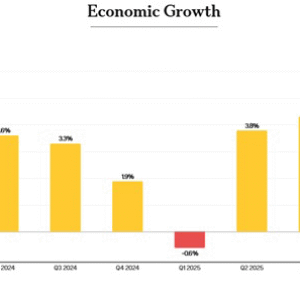
Economic Growth

After a 0.6 percent contraction in the first quarter, U.S. economic growth accelerated and exceeded economists’ expectations in 2025, avoiding a feared recession. GDP grew by 3.8 percent in Q2 and 4.3 percent in Q3—the strongest performance in two years. Although official data for October 2025 through December 2025 are pending, the Atlanta Federal Reserve estimates growth at around 5 percent. Treasury Secretary Scott Bessent expects 2026 to be a “gangbuster year,” with continued strong economic growth.

Inflation

Inflation reached 9.1 percent in 2022, the highest level in decades. Although consumer prices remained elevated through 2025, inflation rates were lower than those recorded during the Biden administration. The annual rate began 2025 at 3 percent, fell to 2.3 percent in April, and rose back to 3 percent five months later. In November and December, price pressures eased, with the 12-month rate slowing sharply to 2.7 percent thanks mainly to falling gas prices.

Trade

Despite the trade deficit widening in the first three months of 2025 as businesses rushed to front-run President Donald Trump’s global tariffs, America’s monthly trade balance has improved substantially. Since peaking at $136 billion, the U.S. goods and trade deficit fell to $29 billion in October—the lowest level in 16 years.

Employment

Since last summer, the U.S. labor market has been characterized by what some economists call “low fire, low hire,” with companies neither reducing nor expanding their workforce. In 2025, employers added 584,000 jobs in total, averaging 49,000 per month. However, job growth slowed as government payrolls fell by 277,000, reflecting the administration’s efforts to shrink the federal government bureaucracy and support private sector jobs.

Gas Prices

One of the major achievements of the Trump administration has been the substantial decline in gas prices. From record production to loosening regulations, businesses and consumers have seen lower energy costs. Crude oil prices are trading below $60, while two dozen states are enjoying average gasoline prices below $2.80 a gallon. Market watchers expect the same trends in the year ahead.

Mortgage Rates

When President Donald Trump started his second term at the White House, the 30-year fixed-rate mortgage was around 7 percent. Since then, it has fallen significantly, even temporarily sliding below 6 percent for the first time in more than three years. This has been driven by a blend of falling Treasury yields and federal housing strategies to bring down costs.

Border Security

President Donald Trump has emphasized border security as a central policy priority. By securing the border, the United States has experienced a 93 percent reduction in border crossings, 622,000 deportations, and 1.9 million self-deportations. This has been accomplished by bolstering enforcement personnel and tightening procedures.

Executive Actions

While the administration secured a major legislative victory with the One Big Beautiful Bill Act, President Donald Trump has used the power of the executive branch to advance many of his policy objectives, including tariffs and regulations. Some of the more than 220 signed executive orders have also drawn legal scrutiny from advocacy organizations, companies, and states, leading to battles that have reached the Supreme Court.

Senate Majority Leader, Sen. Tom McGillvray, R- Billings, has joined two other Montana State Senators, Sen. Greg Hertz, R-Polson and former Sen. Keith Regier, R-Kalispell, in filing a lawsuit challenging the lawfulness of SB 542, which was one of Montana’s major tax reform bills passed by the 2025 State Legislature.

Filed in the Gallatin County District Court, plaintiffs in the case essentially claim that the bill is unconstitutional. It violates at several aspects of Article V, Section 3 of the Montana Constitution.

Sen. McGillvray explained that SB 542 was introduced by Sen. Wylie Galt, R-Martinsdale, as a tax freeze. As it passed through the legislative process it was amended so greatly that its purpose became unrecognizable as to its original intent, which made it unconstitutional according to the three Senators.

“It became a monstrosity,” said McGillvray.

It was introduced to freeze property taxes at their 2024 level, but it became a bill that revised and shifted taxes, provided multiple appropriations and even suspended local city charters, explained McGillvray. ”It became a bill with three different subjects and with multiple appropriations” – all of which stands in violation of the State Constitution, which requires that each bill must deal with only one subject .

Further – it was changed so drastically that the bill’s title no longer reflected its original purpose of freezing taxes at 2024 levels. The Montana Constitution also requires that a bill’s title must accurately reflect its subject matter. The Constitution restricts changing a bill so much that it is changed from its original intent.

Introducing bills dealing with several subjects – “that’s what they do in Congress,” said McGillvray, “They make a big bill with multiple appropriations, that picks winners and losers. They buy enough votes to get it passed. That is what we try to prohibit, so each legislator can look at a single subject.”

“Montanans pride ourselves that our Legislature debates each policy idea on its own merits, with genuine public participation. We’re not Washington, D.C., where massive bills get cobbled together behind closed doors and shoved down legislators’ throats as ‘must pass’ legislation,” continued McGillvray, “ Senate Bill 542 was Washington DC-style corruption. We warned our colleagues on the floor that SB 542 violated Article V, Section 11. We voted to send it to conference committee to fix the constitutional violations. The conference committee ignored the constitutional issues and passed it out with no changes – a sham hearing.”

Violation to Article V section 11: 1-5:

 (1) Change the original purpose of a bill (11) (1) a bill shall not be so altered or amended on it passage through the legislature as to change its original purpose.”  It changed from a 2 page 7 line amendment to freeze property taxes to raise property taxes permanently for some and lower it for others. 

2. . Single subject: (11) (3) (4) each bill except for a general appropriations bill … “shall contain only one subject, clearly expressed in its title.

SB 542 changed from one subject with the purpose to freeze property taxes to at least 3 subjects;

1.  Appropriate 92 million for the $400.00 rebate

2. Revise property tax rates in multiple property tax classes. It raised some rates, lowered others permanently, shifting the reduction from the 80% to the 10%, with the other 10% remaining about the same.

3. It suspended local charters and provided an additional appropriation to cover lost revenue for four years. (This is likely another constitutional violation) of local government powers. 

Senate Bill 542 is to be implemented in two phases. The first phase applied to tax year 2025 and the second phase will generate tax bills that will be issued in November 2026.

From Area Development

Lattice Materials, a manufacturer specializing in custom-grown silicon and germanium crystals and machined components, plans to expand its operations in Bozeman, Montana. The project is expected to create 50 jobs over the next three years.

The company will construct a new 80,000-square-foot facility which will support the increased demand for critical optical components for aerospace and defense industries.

“This new facility marks a pivotal step in our growth as global demand accelerates for high-performance, U.S.-manufactured germanium optics, driven by increased defense investment,” said Travis Wood, president of Lattice Materials. “Expanding our capacity enables our customers to innovate with confidence, maintain resilient domestic supply chains and ensure mission-critical technologies are available when needed.”

The project is being supported by an $18.5 million investment in Lattice from the Department of War.

“Montana is proud to be home to Lattice Materials as a leading manufacturer of germanium and silicon critical for the semiconductor industry,” Montana Governor Greg Gianforte noted. “The investment from the Department of War has led to this important expansion and will create more good-paying jobs and reduce our dependence on foreign nations for critical minerals. Together, we will continue to grow this sector of our economy to keep America prosperous and strong.”

Lattice Materials, part of The Partner Companies, offers services from crystal growth (using the Czochralski process) to final polishing, serving industries needing advanced materials for systems like thermal imaging and guided missiles.

By Mark Stricherz, The Center Square

Since 2020, fraudsters have scammed at least $36 billion and as much as $3 trillion in tax money from federal entitlement programs, dwarfing the amount federal prosecutors claim was stolen in Minnesota’s federal food aid scandal known as Feeding Our Future, an investigation by The Center Square found.

The Center Square reviewed all the statements about entitlement fraud cases issued by the U.S. Department of Justice from 2020 to last year, which did not include many of the cases prosecuted by U.S. Attorney’s offices in the various districts and any state prosecutions.

Public safety net programs such as Social Security, Medicare, and Medicaid lost billions of dollars to scams each year, according to a review of 2,500 DOJ statements, press releases, and fact sheets. The amount ranged from $2.7 billion in 2022 to $14.5 billion in 2025.  

Fraud experts said, if anything, the $36 billion figure is too low. 

“The number doesn’t surprise me,” said Linda Miller, president and co-founder of the Program Integrity Alliance, an independent 501(c)(3) nonprofit, nonpartisan organization that seeks to strengthen government integrity through data, evidence, and public-sector innovation. “That’s fraud that has been identified and investigated, so it represents a fraction of the actual fraud that has occurred or is occurring. Fraud is deceptive, and most agencies lack the tools to proactively prevent it, meaning the actual amount of fraud is much higher.” 

Entitlement fraud has been in the news since November when the Manhattan Institute published an article about mostly Somali residents indicted for defrauding at least $250 million in federal food aid programs with allegations that some of the money went to fund terrorists in al-Shabaab.

Matt Weidinger, a senior fellow at the conservative-leaning American Enterprise Institute, said in an interview that “(w)hatever the fraud that has been uncovered (in Minnesota) is doubtless a fraction of the fraud occurring nationwide.”

He cited a 2024 U.S. Government Accountability Office report concluding that, based on data from 2018 to 2022, the federal government is defrauded of $233 billion to $521 billion annually. While the report examined federal spending overall, Weidinger noted that “entitlement programs constitute the bulk of federal spending and presumably fraud, too.”

The public assistance that suffered the most from the fraud was Medicare and Medicaid, according to a review of Justice Department announcements. In the first half of last year alone, the agency announced that it had identified and investigated approximately $14 billion in fraud in the two federal health care programs, as well as Tricare, the health care program primarily for active-duty military, retirees, and their families.

The figure is more than twice the $6 billion in fraud to federal health programs that the Justice Department identified in September 2020.

The U.S. Sentencing Commission, an independent federal judicial body, concluded that from 2020 to 2024, health care fraud offenses increased by nearly 20 percent.

Fraud prosecutions around the U.S. 

While government officials and experts agree that fraud in Minnesota is substantial, the $250 million figure found in the indictments would barely rank among the ten largest alleged scams from 2020 to last year. Since the Feeding Our Future scandal was announced on September 21, 2022, six other alleged frauds have been larger, with some having nearly as many defendants.

Last month alone, the Justice Department announced two developments in scams centered in Maricopa County, Arizona.

On Dec. 22, Gary Cox, CEO of Power Mobility Doctor Rx, was sentenced to fifteen years in prison and forced to pay $452 million in restitution for defrauding Medicare of $1 billion. According to the Justice Department, Cox and 78 co-conspirators targeted hundreds of thousands of Medicare beneficiaries and convinced them to sign up for medically unneeded pain creams and orthotic braces through misleading mailers, television ads and from offshore call centers.

On Dec. 12, Alexandra Gehrke and her husband, Jeffrey King, agreed to pay $309 million in restitution for defrauding Medicare, Medicaid and Tricare of $900 million from 2022 to 2024. Known as the “glam-flam couple,” they administered unnecessary wound grafts that were ordered because of illegal kickbacks and applied to elderly and terminally ill patients. Each has been sentenced to more than a dozen years behind bars.

Earlier, two medical professionals were convicted of defrauding federal medical entitlement programs.

On March 6, Dehshid Nourian, a Texas pharmacist, forfeited $405 million in assets for defrauding and laundering money from federal workers. According to the Justice Department, Nourian and two other men defrauded the Department of Labor through the submission of fraudulent claims for prescription compound creams to injured federal workers. He was sentenced to 17 years and six months in prison.

In September 2021, Dr. Francisco Patino of Wayne County, Michigan, was convicted of submitting more than $250 million of false and fraudulent claims submitted to Medicaid, Medicare, and other health insurance programs.

According to the Justice Department, Patino excessively prescribed highly addictive opioids to his patients at his medical clinic in Livonia, prescriptions that forced his patients to receive lucrative spinal injections. If patients refused, Patino would take away their opioid prescriptions, prosecutors alleged. While another 21 defendants were sentenced in the conspiracy, Patino received the stiffest sentence—16.5 years in prison.

In December 2022, Minal Patel of Atlanta, owner of LabSolutions LLC, was convicted of defrauding Medicare of $463 million. According to the Justice Department, Patel conspired with patient brokers, telemedicine companies, and call centers to target Medicare beneficiaries with calls falsely stating that Medicare covered expensive cancer genetic tests. In August 2023, Patel was sentenced to 27 years in prison.

In September 2022, Biogen Inc., a Cambridge, Mass-based biopharmaceutical firm, reached a $900 million settlement for defrauding Medicare and Medicaid.  According to a whistleblower’s complaint, from January 2009 to March 2014 Biogen gave speaker honoraria, training fees, consulting fees and meals to medical professionals who spoke or attended the company’s programs to convince them to prescribe three of its drugs to treat multiple sclerosis.

As large as those entitlement frauds were, even they scratch the surface of the nearly 300 cases the Justice Department announc-ed from 2020 to last year. Most were announcements of convictions, guilty pleas, and sentencing. They involved not only doctors and medical firms, but also universities, hospitals, corporations, bookkeepers, accountants and state agencies.  

Fraud experts reject the notion that scams are the natural byproduct of government contracts and oversight.

In a 2023 article, Miller wrote that cabinet officials and agency leaders should be held responsible for the fraud under their watch. 

“Fraud is unfortunately not an issue many agency leaders prioritize,” she said in an interview, “and the number of programs that have scaled up their preventative tools and capabilities is woefully small.”

Feds crack down in MN

On Dec. 18, Joe Thompson, then the acting U.S. Attorney for Minnesota, said scam artists have defrauded the state’s fourteen Medicaid programs of more than $9 billion. Governor Tim Walz, a Democrat, disputes the figure, though in October he announced that the state would delay fourteen Medicaid payments run by the state’s Department of Human Services.  

Since the fall, the Trump administration has seized on entitlement fraud in Minnesota, a state where Democrats occupy all the statewide elected offices and hold a narrow majority in the state senate. On Sept. 21, 2022, the Justice Department announced it indicted 47 defendants for committing $250 million of alleged fraud in a federally funded child nutrition program run by the nonprofit organization Feeding Our Future.  

Minnesota’s office of the legislative auditor released two detailed reports on fraud, on the federal-state childcare assistance program in 2019, and two federal food aid programs in 2024, both of which found fault with state agencies failing to detect scams earlier. Yet the chicanery did not become national news until this fall.  

On Nov. 19,  an article by the Manhattan Institute alleged that the defendants, nearly all of whom were Somali, were sending some of the stolen entitlement money to Al Shabaab, an Islamic terrorist group fighting the government in a decades-long civil war in one of the poorest countries on earth. Two days later, President Trump announced on TruthSocial that he was terminating temporary protected status for Somalis in Minnesota, a designation given to them because the Horn of Africa nation suffered from not only civil war but also famine. 

The think tank’s accusations of diversions of the money to terrorists have not been proven, but the scandal hit a fever pitch after conservative populist influencer Nick Shirley on Dec. 26 posted a YouTube video of Somali-run daycare centers in Minnesota devoid of children. The video received more than 100 million views. 

On Jan. 5, the Trump administration froze federal subsidies for childcare, social services, and cash support for poor families in five states, all controlled by Democrats, including Minnesota. 

On Jan. 8, Vice President J.D. Vance announced the administration would create a new assistant attorney general for fraud detection — a position based in the White House.

While national in scope the official will “focus primarily” on Minnesota’s fraud scandals.